Williams SonomaCookware
The original Williams Sonoma store in Sonoma, California, 1956

Since 1956

Heritage & Quality Standards

The story of Williams Sonoma is the story of one man's conviction that American home cooks deserved the same tools used by the great chefs of France. Since Chuck Williams opened the doors of his first store in Sonoma, California in 1956, that conviction has never wavered.

1956Year Founded
Sonoma, CAOrigin
Italy & FranceCrafted In
PFOA-FreeCoatings

Chapter 1

The 1956 Origin Story

Chuck Williams did not set out to build a retail empire. He was a carpenter and avid home cook who, in 1953, took his first trip to France and walked into the copper-lined kitchen supply stores of Paris. What he saw changed everything: professional chefs worked with tools of extraordinary precision and beauty — carbon-steel knives that held an edge for weeks, copper sauciers that responded to the faintest adjustment of heat, cast-iron pans that had been seasoned for decades.

When he returned to California, he could not find a single store that sold those tools. American hardware stores stocked thin aluminum pots and pressed-steel skillets. Fine department stores carried decorative cookware that looked beautiful but performed poorly. Chuck saw a gap no one had filled: a store dedicated entirely to serious cooking equipment for serious home cooks.

In 1956, he bought a hardware store in Sonoma, gutted it, and stocked it with the French and Italian cookware he had personally sourced on a second trip to Europe. He imported tinned copper saucepans from Lyon, carbon-steel frying pans from a Parisian manufacturer, and fluted tart rings from a small atelier in Burgundy. On opening day, home cooks drove from San Francisco — more than 40 miles — to see what he had assembled.

"I just wanted to sell the things I wished I could have found when I started cooking."

— Chuck Williams, Founder
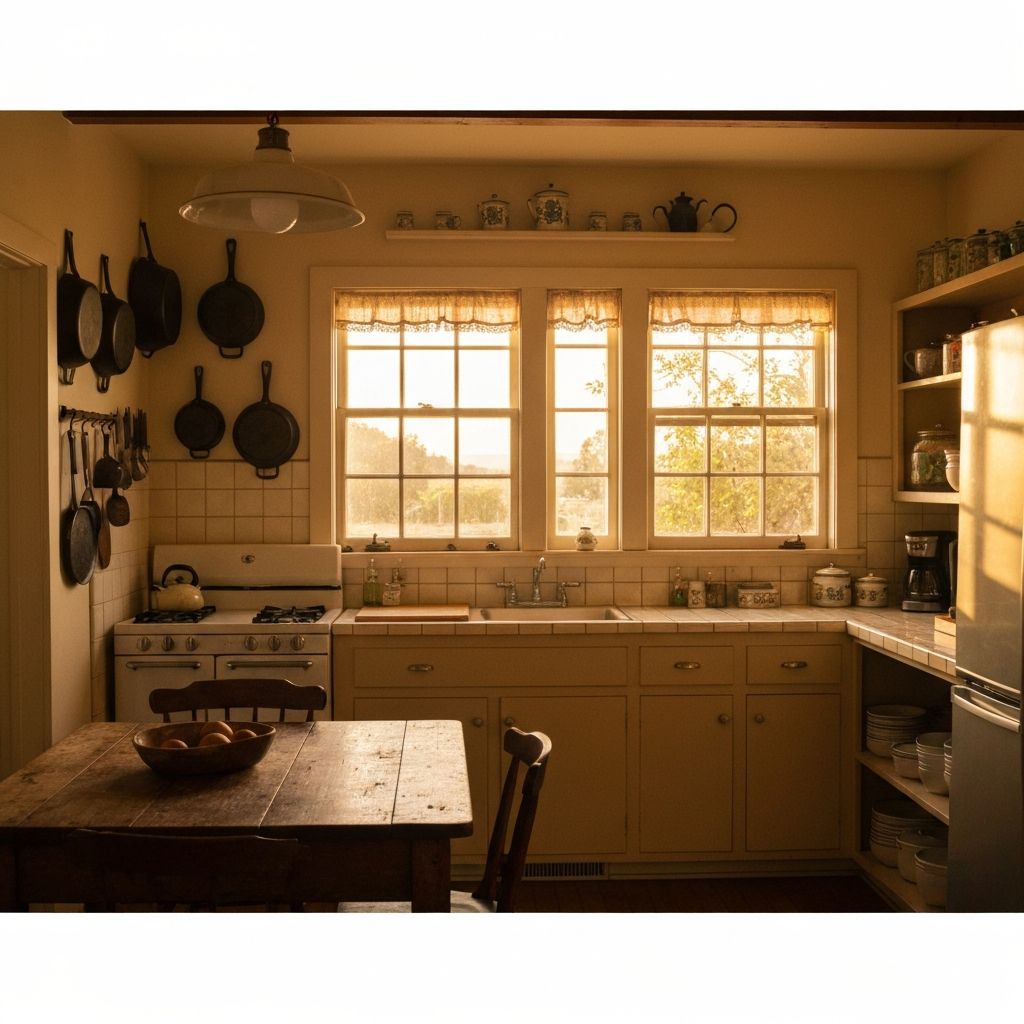
The original Williams Sonoma store atmosphere in 1956 Sonoma, California

Sonoma, California — 1956

The original store where it all began

56
1956

The First Store Opens

Chuck Williams opens a small hardware store in Sonoma, California, and fills it with the French copper cookware he discovered on a trip to Europe. He is the first American retailer to import professional-grade cooking equipment — wire whisks, copper sauciers, fluted tart pans — for home cooks.

58
1958

Moving to San Francisco

Demand grows so quickly that Chuck relocates the store to Sutter Street in San Francisco. The city's culture of serious cooking and fine dining creates a natural home for the brand. Within months, the store becomes a destination for chefs, food writers, and passionate home cooks across the Bay Area.

72
1972

Introducing the Catalog

Williams Sonoma launches its mail-order catalog, bringing professional cookware to American kitchens coast to coast. For home cooks in cities without a Williams Sonoma store, the catalog becomes their window into a world of cookware previously available only to restaurant professionals.

83
1983

Going Public

Williams Sonoma, Inc. goes public on the New York Stock Exchange, signaling the brand's transformation from beloved San Francisco specialty store into a national institution. The company expands to over 100 locations while maintaining the exacting quality standards Chuck established in that first Sonoma store.

ay
Today

A Global Standard for Home Cooking

Williams Sonoma now curates cookware from the world's most respected manufacturers — Thermo-Clad engineered in Italy, Le Creuset handcrafted in France, All-Clad forged in Pennsylvania. The common thread across every product is the original standard: professional quality, built for the home cook who refuses to compromise.

Chapter 2

Commitment to Craftsmanship

Williams Sonoma does not manufacture cookware in a single factory on a single continent. Instead, the brand partners with the finest specialist makers in the world — choosing each manufacturer for their mastery of a specific material. "Made in Italy" and "Handcrafted in France" are not marketing phrases on a Williams Sonoma product. They are production realities.

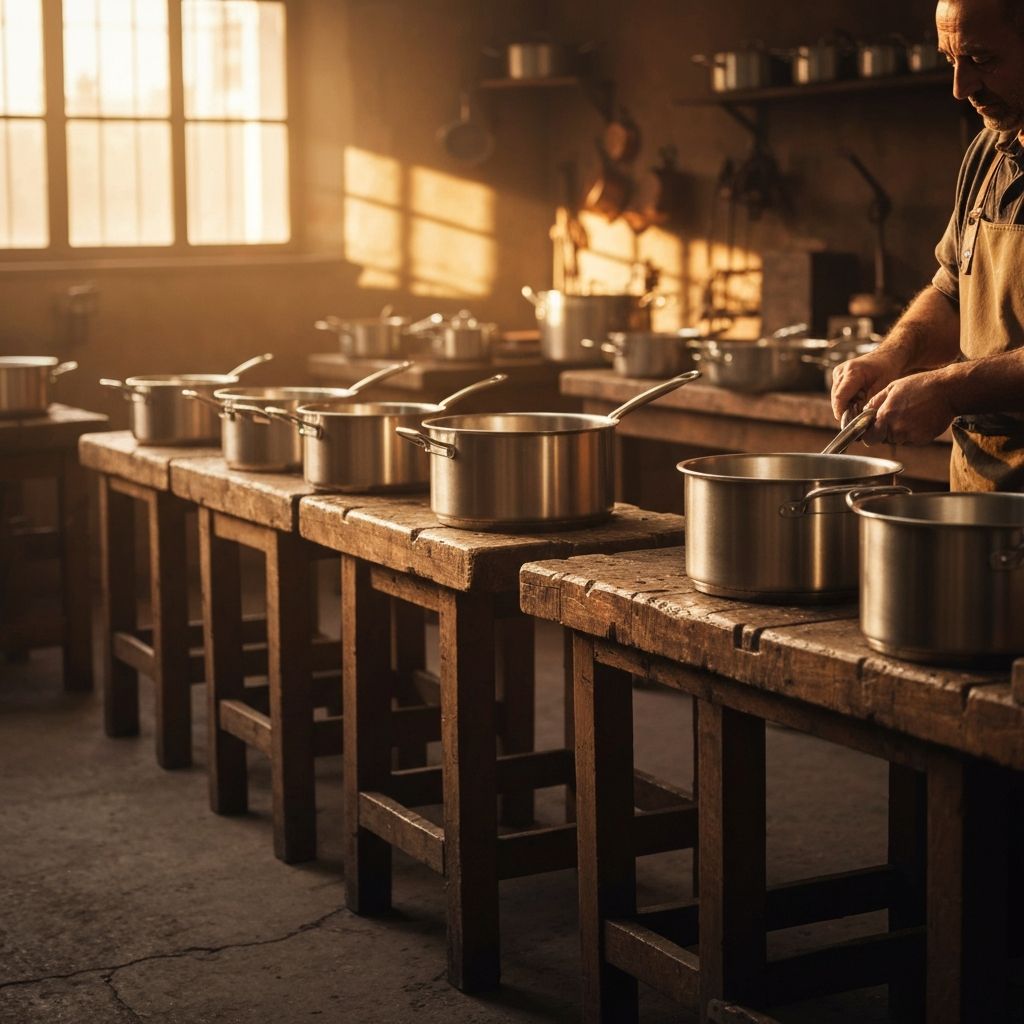
Artisan metalworking in Northern Italy — the production home of Williams Sonoma Thermo-Clad cookware

Handcrafted. Tested. Guaranteed.

The Williams Sonoma production standard

Thermo-Clad Stainless Collection

Made in ItalyNorthern Italy — Piedmont Region

The Williams Sonoma Thermo-Clad line is manufactured in the Piedmont metalworking tradition of northern Italy, a region that has been producing precision metalwork since the Renaissance. Each pan begins as a flat disc of 18/10 stainless steel that is cold-pressed, not cast, around an aluminum core — a process that creates a seamless molecular bond between layers with no air gaps that could cause uneven heating.

The handles are machine-finished, then hand-tested for balance by experienced technicians who reject any piece that does not meet Williams Sonoma's specified resistance tolerances. The interior cooking surface is electropolished to a smoothness that resists bacterial adhesion and improves food release without nonstick coatings. Every finished piece is shipped to a Williams Sonoma quality control facility in Italy before export, where it undergoes a final thermal imaging test to verify even heat distribution.

Production Specifications

  • 18/10 Stainless Steel Interior
  • 5-Ply Fully-Clad Construction
  • Cold-Pressed Aluminum Core
  • Electropolished Interior Surface
  • Hand-Balanced Stainless Handles
  • Thermal Imaging QC Verified

Le Creuset Enameled Cast Iron

Made in FranceFresnoy-le-Grand, Northern France

Le Creuset has operated its foundry in Fresnoy-le-Grand since 1925, and the process for creating each piece of enameled cast iron has changed remarkably little in that century. Molten iron is poured into individual sand molds — each mold destroyed after a single use, ensuring no two pieces are exactly identical. The raw casting is then ground, cleaned, and inspected by hand before the enamel is applied in two separate firings at temperatures exceeding 820°C.

The signature enamel interior begins as a dark primer coat that bonds directly to the iron at the molecular level, followed by a smooth, lighter topcoat that provides the non-reactive cooking surface. The exterior color — like the exclusive Williams Sonoma Forêt green — is applied in a third firing. Williams Sonoma works directly with Le Creuset's color laboratory to develop exclusive shades unavailable elsewhere, making select pieces genuine collectors' items.

Production Specifications

  • Individual Sand-Cast Molds
  • Triple-Fired Enamel Coating
  • 820°C Firing Temperature
  • Non-Reactive Interior Enamel
  • Exclusive Williams Sonoma Colors
  • Lifetime Warranty Against Defects

All-Clad — Canonsburg, Pennsylvania, USA

American-Made Since 1971

All-Clad has manufactured its cookware in Canonsburg, Pennsylvania, since John Ulam invented the bonded metal cladding process in 1971. The same town that produces the D3, D5, and Copper Core collections also supplies bonded metals to NASA and the defense industry. Every piece of All-Clad sold through Williams Sonoma carries the same lifetime warranty as the original Ulam design and is backed by a US domestic repair program.

Hand-Finished Stainless Exterior
Lifetime Limited Warranty
US Domestic Repair Program
Military-Grade Bonding Process

Chapter 3

Sustainability & Safety

Premium cookware and responsible manufacturing are not in opposition — at Williams Sonoma, they are the same commitment. The brand has consistently moved ahead of regulatory requirements on chemical safety, and its flagship lines are built on a "Buy It For Life" philosophy that is inherently the most sustainable approach to cookware.

A pan that lasts 40 years is categorically more sustainable than four pans that each last a decade. The material quality, ethical sourcing, and chemical safety standards that make Williams Sonoma cookware perform better also make it the more responsible choice for the planet.

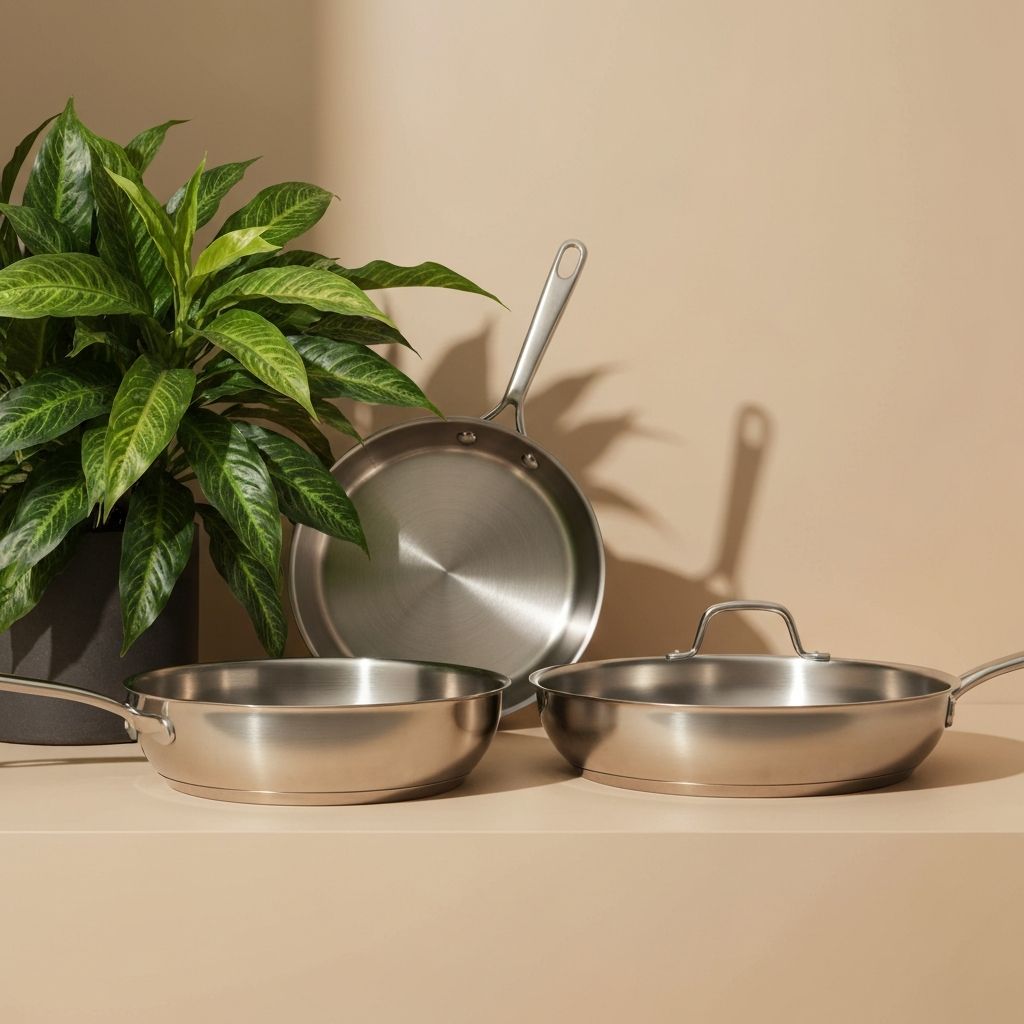
Williams Sonoma's commitment to sustainable, ethically sourced cookware materials

PFOA-Free. Ethically Sourced. Built to Last.

PFOA-Free Coatings

Every nonstick surface sold through Williams Sonoma has been PFOA-free since 2013 — well ahead of the regulatory deadline. The Professional Nonstick line uses a triple-layer hard-anodized coating that is also PTFE-free on the highest-heat variants, eliminating the chemical concerns associated with older Teflon-era pans entirely.

In Practice

Williams Sonoma conducts independent third-party laboratory testing on every nonstick coating formulation before approving it for sale. Test reports are retained for a minimum of 10 years and are available to customers on request.

Ethically Sourced Materials

The stainless steel in Thermo-Clad cookware is sourced from certified European mills that operate under EU environmental standards — some of the strictest in the world. The aluminum core alloy is sourced from suppliers who use hydroelectric power for smelting, significantly reducing the carbon footprint of each pan versus coal-fired alternatives.

In Practice

Le Creuset's iron is sourced from mills that maintain ISO 14001 environmental certification. The enamel pigments used in their color glazes are free of lead and cadmium, verified by independent testing laboratories before use.

"Buy It For Life" Durability

Williams Sonoma's premium cookware lines are explicitly designed under the "Buy It For Life" (BIFL) philosophy — meaning a single purchase should serve a cook for decades, not years. Thermo-Clad carries a limited lifetime warranty. All-Clad's lifetime warranty covers manufacturing defects for the life of the original purchaser. Le Creuset backs its cast iron with a lifetime guarantee.

In Practice

The environmental logic of BIFL is compelling: a single cast-iron Dutch oven that lasts 50 years represents a fraction of the resource consumption of replacing cheap cookware every 3–5 years. Williams Sonoma actively promotes this calculation to its customers.

Responsible Packaging

Since 2020, Williams Sonoma has transitioned its premium cookware packaging to 100% recycled cardboard and soy-based inks. The foam inserts used in Thermo-Clad shipments are made from plant-based materials and are fully compostable. The brand has committed to eliminating all single-use plastic from its packaging supply chain by 2026.

In Practice

Williams Sonoma publishes an annual sustainability report detailing progress against packaging, supply chain, and carbon goals. The 2024 report recorded a 34% reduction in total packaging material weight versus the 2019 baseline.

Chapter 4

The Williams Sonoma Test Kitchen

No Williams Sonoma cookware product reaches customers without first passing through the brand's professional test kitchen — a fully equipped commercial cooking space staffed by a permanent team of culinary professionals. This is not a showroom or a marketing exercise. It is a genuine quality gate.

The test kitchen standard is rigorous by design. Williams Sonoma's founder Chuck Williams set the original rule: if a product does not perform better for a home cook than whatever they already own, it does not belong in the store. That rule has not changed in nearly 70 years.

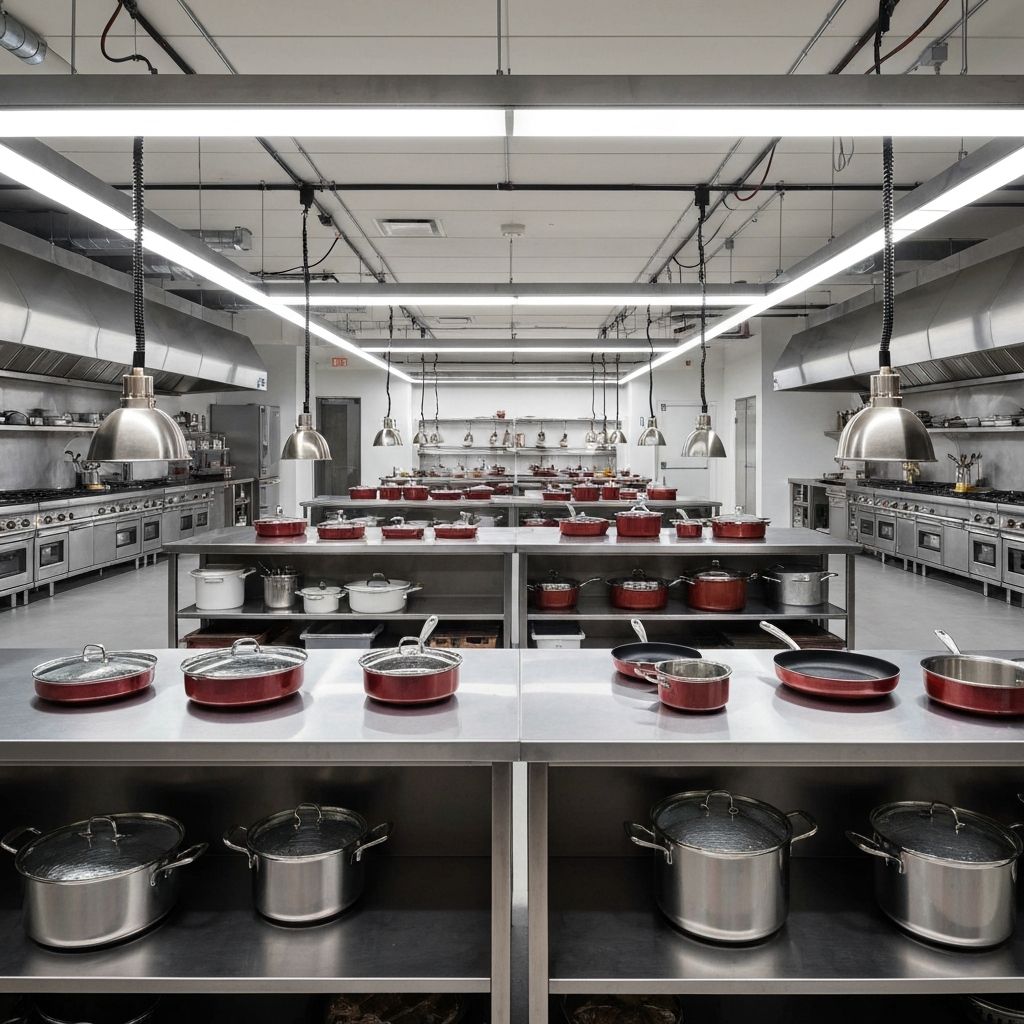
Williams Sonoma professional test kitchen where every product is evaluated before reaching customers

The Test Kitchen Standard

500 thermal cycles. 200 dishwasher hours. Real-cook validation.

The 5-Stage Testing Process

01

Initial Performance Testing

Every new product submitted for consideration undergoes a standardized battery of performance tests: heat distribution mapping using thermal cameras, boiling time benchmarks, sear quality on protein samples, and oven temperature consistency tests. Products that fail to meet minimum thresholds at this stage are returned to manufacturers with detailed specifications for improvement.

02

Durability & Longevity Assessment

The test kitchen subjects cookware to accelerated aging protocols: 500 thermal cycles (rapid heating and cooling) to test for warping; 200-hour dishwasher trials for dishwasher-safe claims; 1,000-cycle handle torque tests to ensure rivets and welds hold under repeated use. Nonstick coatings are tested with metal utensils to verify abrasion resistance claims.

03

Real-Cook Validation

Williams Sonoma's culinary team of professional chefs uses each tested product across a full range of real cooking tasks — not just benchmark tests. They cook eggs, sear duck breast, make caramel, bake focaccia, and braise short ribs. Their qualitative feedback on handle ergonomics, pour control, lid fit, and cleaning ease informs the final go/no-go decision.

04

Home Cook Panel Review

Before a product reaches the floor, it spends 60 days with a panel of volunteer home cooks of varying skill levels who use it in their own kitchens for everyday meal preparation. This panel provides crucial feedback on real-world durability, ease of cleaning, and any ergonomic issues that only emerge during sustained daily use rather than controlled testing.

05

Ongoing Quality Monitoring

After launch, Williams Sonoma's quality team monitors customer reviews, return rates, and service calls on an ongoing basis. Any product generating elevated return rates or quality complaints triggers an immediate audit of the manufacturing batch. This closed-loop quality monitoring is one reason Williams Sonoma cookware consistently outperforms broader market alternatives on customer satisfaction.

"The test kitchen is the reason every product we carry has earned its place. We don't sell cookware because it's attractive or popular — we sell it because our culinary team has proved it makes better food."

— Williams Sonoma Culinary Director

Where to Go Next

Ready to Choose Your Collection?

Armed with the full story of Williams Sonoma's heritage and standards, use our comparison guide to find the exact line that suits your cooking style — then shop with confidence on Amazon.

Browse All Williams Sonoma Cookware

As an Amazon Associate we earn from qualifying purchases.